

People often ask whether recovery programs actually work because many have seen them fail—at least on the surface. Someone attends for a few weeks, stops going, relapses, or ends up back in the system. From the outside, it can look like the program didn’t help.
What long-term research shows, however, is something more nuanced. Recovery works best when it is supported over time, not when it is rushed or treated as a one-time requirement. Outcomes improve when people remain engaged within structured systems that provide consistency, accountability, and clear expectations—especially during the early months when risk is highest.
Why Recovery Success Is Often Misunderstood
Recovery is often judged too quickly. Some studies measure success at 30 days, others at one year, while many overlook broader signs of progress such as steady employment, compliance with court requirements, or reduced involvement with the justice system. When short-term abstinence is treated as the only marker of success, long-term stability can be easy to miss.
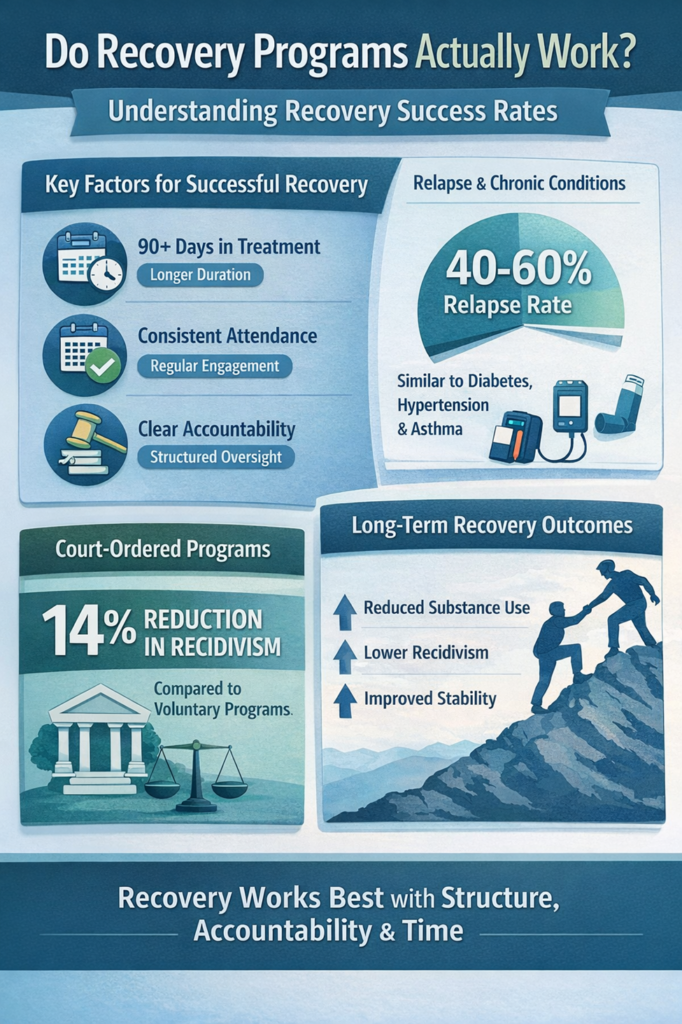
Relapse statistics are also frequently misunderstood. Research summarized by the National Institute on Drug Abuse shows relapse rates of roughly 40–60 percent, similar to other chronic medical conditions such as diabetes or asthma. This comparison reflects a widely accepted reality: addiction, like other chronic conditions, often requires ongoing management. Relapse alone does not mean recovery has failed. Losing connection and structure does.
What Research Shows Actually Improves Recovery Outcomes
Across decades of research, a few patterns appear again and again. One of the strongest predictors of long-term stability is simply staying engaged. Findings compiled by the Substance Abuse and Mental Health Services Administration show that people who remain connected to recovery-oriented programs longer experience lower substance use, better mental health, and greater overall stability. These benefits appear across many different models, suggesting that consistency matters more than the specific format of the program.
Why Time Matters More Than Intensity
One of the clearest findings in recovery research is that time in treatment matters. Evidence summarized by the National Institutes of Health through its National Institute on Drug Abuse (NIDA) shows that most individuals need approximately three months (about 90 days) of continuous engagement to significantly reduce or stop substance use, with longer durations associated with better outcomes. This early phase of recovery is also when relapse risk is highest, with research showing that disengagement during the first weeks and months substantially increases the likelihood of relapse—making consistent attendance and accountability especially critical during this period.
Why Attendance and Engagement Matter
Attendance is more than checking a box. Regular participation creates routine, accountability, and connection—factors that are especially important early in recovery. Longitudinal findings referenced by the Substance Abuse and Mental Health Services Administration link consistent participation with improved employment outcomes, reduced substance use, and lower levels of justice-system involvement.
Programs that track attendance are better able to notice when someone starts to drift and respond before that drift turns into a relapse or violation.
Why Accountability Helps When Motivation Fades
Motivation is rarely steady, especially early on. Stress, fatigue, and outside pressure can all make it hard to stay consistent. Research summarized by the National Institute of Justice shows that accountability helps stabilize behavior during these low-motivation periods. Clear expectations and follow-up reduce the need to rely on willpower alone, which is often unreliable when life gets complicated.
Structured Recovery Compared to Going It Alone
Some people do succeed on their own—but population-level data paints a different picture. The National Institutes of Health notes that many people initially try to stop without treatment, yet structured support tends to improve stability and outcomes (see Principles of Drug Addiction Treatment). In fact, NIH-funded research on “natural” remission has found it can be followed by a high likelihood of relapse, suggesting that outside monitoring and preventive support may be important even after someone cuts back on their own (see Rates and predictors of relapse after natural and treated remission). Without external structure, early disengagement is easier to miss—until relapse or renewed system involvement makes it visible again.
Understanding Relapse Risk Over Time
Relapse risk is not random. The first 90 days are consistently identified as the most vulnerable period. This is why early recovery focuses on frequent engagement and clear expectations.
As engagement continues, risk declines. Over time, participation builds stability that reduces both substance use and repeated involvement with courts or probation systems.
Do Court-Ordered Recovery Programs Make a Difference?
Court-ordered recovery is sometimes viewed skeptically, but research suggests it can be effective. Meta-analyses summarized by the U.S. Department of Justice show that drug treatment courts are associated with roughly a 14 percent reduction in recidivism. These outcomes are largely driven by consistent oversight, measurable participation, and timely responses when engagement begins to slip.
Why Relapse Does Not Mean Recovery Has Failed
Relapse is common, especially early, and does not mean recovery has failed. Long-term recovery research shows that many people need more than one period of structured support before achieving lasting stability.
What matters most is what happens next. Rapid re-engagement and continued support lead to better outcomes than removal from programs or escalation without intervention.
Why Measuring Participation Makes Recovery Systems Work Better
Progress in recovery can be difficult to measure day to day, particularly outside clinical settings. Participation, however, is visible and measurable. Justice-focused research from the U.S. Department of Justice shows that systems emphasizing measurable participation experience fewer technical violations, less administrative friction, and better overall outcomes for both individuals and supervising agencies.
What Long-Term Recovery Data Really Tells Us
Long-term recovery data does not offer simple yes-or-no answers. Instead, it shows that recovery improves when people stay connected, supported, and accountable over time.
Programs that focus on participation and engagement—rather than short-term outcomes alone—are better positioned to reduce relapse, recidivism, and repeated system involvement. Recovery works best when it is treated as a process, not a deadline.